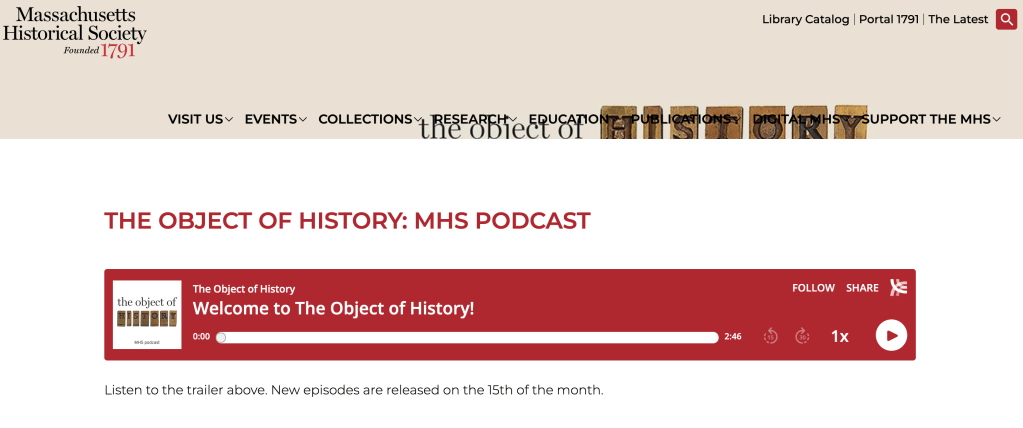
by Otelia Lighthill
The Object of History: MHS Podcast. Massachusetts Historical Society. Podcast audio. 3 September 2021. https://www.masshist.org/podcast-tooh.
The Object of History from the Massachusetts Historical Society paints a vibrant and segmented view of the roots of the United States. Located in Boston, the team of historians and scholars guide the listener through a journey down the rows of the Society’s archives. In the format of an interview setting, the podcast team collaborates with visiting historians, researchers, students, and scholars to share their archival objects and research with the audience. The theme of accessibility and storytelling is apparent throughout each episode. Things like the roots of the liberty tree, Benjamin Joy’s Sea Chest, and a portrait of President George Washington are not so easily found in public history, nor are they likely sought after by the average podcast listener. The Object of History brings these mystifying objects right to the listener’s device, creating a world of early American history that sounds like music to the ears.
Spearheaded by Peter Drummey, Chief Historian and Stephen T. Riley Librarian at the MHS, his experience in library outreach and exhibition sets the stage for the contextual deep dive of the podcast. Having assisted 50,000 researchers who’ve visited the MHS, Drummey holds valued experience in creating accessible and honest reviews of history. Frequent co-hosts and guests, Cassie Cloutier and Anne Bentley, bring in hands-on experience from research in the archive. Cloutier is the Assistant Director of Research at the MHS. As producer and co-host of The Object of History, Cloutier interviews and guides visiting scholars into illustrating the archival objects featured in the episodes. Bentley frequently visits as an expert on objects found in the MHS. Having been with the Society since 1973, first as conservator of manuscripts and then as curator of the art collection, Bentley moved into her position as responsible for the Society’s numismatic collection in 1984. Additional valuable team members include Sam Hurwitz, a fifth-year PhD candidate in the History Department at Boston College and Kanisorn Wongsrichanalai, director of Research at the MHS. The conjoined expertise of all five team members brings together a web of passion and experience that makes the podcast what it is.
The Object of History is arguably a hallmark of creating for public history. Playing on its theme of accessibility and engagement, the podcast creates 30-40 minute episodes that can be listened to in any capacity. Whether to hone in on a specific topic in a classroom or to pass the time while walking the dog, various topics like Illuminated manuscripts and a World War II Bombers Canine companion are available at the touch of a button. That button is found on major podcasting sites and on the MHS’s own official website. By creating this interactive atmosphere for guests and listeners, the podcast brings history directly to the public, bringing its area of scholarship too. Essential team members like Sam Hurwitz bring experience in the digital humanities to the podcast, contributing deeply to podcasting as its own educational field of public history.
The podcast itself teeters on the edge of a calm paced yet engaging form of public history. At times, the interview format shifts to a one person lecture, limiting the engagement of the duo-interview dynamic, and the attention of the listener as well. Despite that, the interviewers often swap out with guests, giving room for flexibility and change that keeps the audience ready for more. When interviewers and guests really begin to engage in passionate dialogue on a given topic, the podcast truly shines. The sound quality shifts in and out, occasionally feeling of lower quality or quieter stature, yet upholds its calm and pristine listening environment. Without clearly labeled seasons on non-MHS podcast platforms, a listener may find it overwhelming and confusing to start off. With a little more digging and research, it’s a little easier to find a way around The Object of History. Whether that makes it more accessible for those willing to search, or less accessible for those looking for easy listening, the podcast provides something for everyone in some capacity.
The MHS’s podcast is meant to reach an audience that is not so easily inclined to explore the wide array of archival objects. Archives are often available by appointment and necessity of research. Beyond that, listeners can access digital exhibitions and collections through the Society’s website. Yet instead of weaving through the hoops and hurdles of knowing exactly what you’re looking for in an archive, the MHS makes unconventional material readily available right to a listener’s device. Even more, the objects become that much more engaging when presented by passionate guests on the podcast. In the episode, “To live like John Quincy Adams,” Gwen Fries, the Production Editor of the Adams Papers at the MHS, discusses an experiment conducted during lockdown in 2020. Fries spent a week of her life living like John Quincy Adams, reading like him, sleeping like him, exercising like him, and more.[1] Craving structure and stability, Fries placed herself into a structural routine that provided both historical experience and a new outlook on life. She described her experience as fully immersive, saying that no one she knows today gets nearly half as much done as Adams did in his time. Fries also felt she really got to know him, understanding what made him laugh and what made him cry. Knowing how much time he dedicated to his family outside of work hours, she got the chance to personally know someone that lived centuries before her. Through her experience, the audience learns the personality of Fries as someone studying history, and Adams as someone living in history. By extension, the listener gets an even more rewarding experience of learning when they learn to understand what makes history engaging, and how someone like Fries actively creates engagement through curiosity and passion.
Another example of the immersive nature of the MHS podcast is the episode, “”Holding the Atlantic World in His Mouth”: George Washington, an MHS Portrait, and the Culture of Teeth in the 18th Century.” PhD candidate Lucy Smith, from the University of Michigan in the joint History and Women & Gender Studies program, brings in her own personal experience as an Education Specialist at George Washington’s Mount Vernon. Smith helps contextualize Washington’s teeth struggles with the broader history of the time. Although the buying and selling of human teeth is a rarity for humans now, the desperation of people in pain like Washington, and the desperation of people in need of income like those who sold teeth contextualizes the medical field at the time. Smith, as a guest on the podcast, builds upon her own personal experience from George Washington’s Mount Vernon and the scholarship that they’ve already established as stewards of an existing primary source. The George Washington’s Dentures FAQ page answers, or fails to answer, many questions regarding the sets of teeth the late president once owned.[2] However, a problem visitors and researchers may run into is the lack of answers. A surfer on the web may be frustrated by the repetition of “we don’t know” to many questions featured on the page. However, isn’t that history? The Mount Vernon researchers glean as much information as they can from the primary sets of teeth, but they can never actually stand in those shoes, or wear those dentures. The beauty of history is exactly that. The MHS and Mount Vernon help contextualize and exhibit as much as they can until the very last perspective they are missing is the person themselves.
George Washington’s dentures offer a foundational basis for interdisciplinary research from all sides. Jennifer Van Horn presents a multifaceted approach in her article, “George Washington’s Dentures – Disability, Deception, and the Republican Body.” Van Horn explores the early field of dentistry, the perspective of the president, and the perspective of enslaved people who contributed their teeth to his dentures. She pointedly notes the importance of Washington’s dentures in creating a presidential image.[3] Her research dives into the world of dentures and disability, sharing a similar theme with another episode of the MHS podcast, “Gouverneur Morris and the History of Disability.” Van Horn expands on her own analysis, but the MHS is able to take it just a step further. Both the episode and Van Horn are in the midst of swirling scholarly conversation surrounding the history of glorified American leaders and their connections to slavery. Van Horn’s scholarship sets a foundation for the different work that the MHS chooses to take on. She identifies factors in cultivating a presidential image and identity, and the MHS podcast completely picks that identity apart. Using her experience from Mount Vernon, Smith confronts the challenging history, and the everlasting question, did Washington’s dentures come from enslaved people? Smith acknowledges that we still don’t technically know where the dentures came from, even though it is entirely likely, based on research and records. Although the podcast came to the similar conclusions of already existing scholarship, The Object of History is still changing the game. Instead of secondary sources, the MHS is able to directly engage with primary sources available in its archives. Those archives then become readily available, by ear, to thousands of listeners of the podcast. In a world of waiting-games and long journeys to the archives, the Massachusetts Historical Society delivers quality content, knowledge, and analysis directly to a listener’s device. Accessibility is the name of the game, and is changing the scope of public history for many years to come.
No one does storytelling quite like the podcasting team at the Massachusetts Historical Society. The listener of The Object of History gets a front row seat to some of the best research in the country. Guided by calm music and intriguing interviews, someone can walk away from this podcast with more contextual knowledge of George Washington’s dentures than anyone ever has before. What feels like an in-person journey of immersive history in the early years of the United States turns out to be a 30 minute episode lasting the duration of a walk across campus. Literary themes and imaginary visuals shine in this illustrious podcast from one of the oldest Historical Societies of our country.
[1] Gwen Fries. “To Live Like John Quincy Adams.” The Object of History: MHS Podcast. 14 May 2023. https://www.masshist.org/podcast/season-2-episode-7-to-live-like-john-quincy-adams.
[2] “George Washinton’s Dentures FAQ.” George Washington’s Mount Vernon. https://www.mountvernon.org/george-washington/health/washingtons-teeth/teeth.
[3] Horn, Jennifer Van. “George Washington’s Dentures: Disability, Deception, and the Republican Body.” Early American Studies: An Interdisciplinary Journal 14, no. 1 (2016): 14. https://dx.doi.org/10.1353/eam.2016.0000.
 Podcasting History
Leave a comment