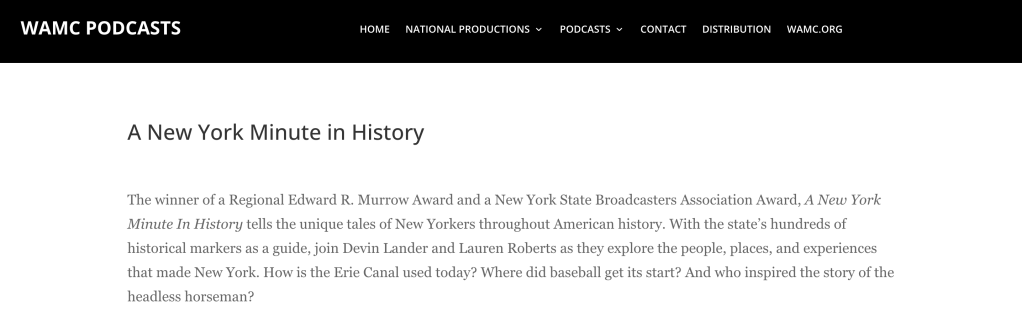
A New York Minute in History podcast. WAMC. Devin Landers and Lauren Roberts, hosts. https://wamcpodcasts.org/a-new-york-minute-in-history/. May 2018- present.
Reviewed by Kathryn L.
Is your dad a baseball fanatic who detoured your family trip to visit the birthplace of baseball in Cooperstown, New York? Well mine is, and while I opted not to wander through the baseball museum, I instead wandered the town, reading about its history as the birthplace of James Fenimore Cooper on markers around the village. It got me interested in what other history New York had to offer, which is how I stumbled on a podcast that offers exactly that: A New York Minute in History is a podcast whose episodes focus on New York history, based on historical markers around the state.
Produced by the New York State Museum, WAMC radio, and Archivist Media, with support from the William G. Pomeroy Foundation, the podcast tells the tale of people, places, and events within, or originating in, New York state. Started in 2018 and continuing through today, the podcast does not focus on one moment in New York history specifically, but each episode is its own story. There are 62 episodes, each one being released about every 30 days, though there are many gaps in between months, making the schedule sporadic and difficult to identify. I listened to ten episodes, focusing on women’s history and African American communities, but topics range anywhere from the construction of the Erie Canal, to the birth and history of baseball, to the legend of the Headless Horseman. The two hosts, Devin Landers, the New York State historian, and Lauren Roberts, the historian for Saratoga County, share their knowledge of the state and area they live in, additionally bringing in guests to help elaborate on a story or give personal details.
The podcast was established to connect listeners of a general audience with New York history, and to connect that history with the present moment we are living in today. The final product is an entertaining, engaging, and informative snippet of history that is relevant not only to New Yorkers but to anyone throughout the country, due to its ability to connect history with the present. For example, one episode, “The Women’s Rights Movement: From Seneca Falls to Today” talks about the history of women’s rights, but does so by going through the female descendants of Elizabeth Cady Stanton, talking about how each one has contributed to the women’s rights movement in her own generation.[1] Through it all, the great-great-granddaughter of Stanton, Coline Jenkins, shares her family’s history and her own presence in protests for the #MeToo movement, revealing through family and events how the women’s rights movement has evolved into the present.
The podcast has its own website on which one can find a concise summary of the podcast and its producers, as well as all of the episodes produced so far.[2] Each episode has its own tile, with a picture, title of the episode, and small summary of the topic discussed on the home page. When you choose an episode, you are brought to its own page, which includes a picture relevant to the topic at hand– usually of a person or place– a picture of the historical marker which prompted that podcast episode, who the guest speakers on the episode are, resources used for the episode and for further reading, and a transcript. All of this was incredibly easy to locate and the website a breeze to navigate, offering a plethora of information and resources without making the website feel disorganized. I especially appreciated the resources for further reading, demonstrating that not only is the podcast introducing us to public history, but actively encouraging listeners to learn more about that history as well, and offering them the means to do so.
The episodes both build on and build up previous historiography in its various topics. In the episode “Grace Leach Hudowalski,” the hosts carve out a new space for pioneering female hikers, building off of Hudowalski’s own book, The Adirondack High Peaks and the Fort-Sixers and hiking guides and geographical histories of the Adirondacks themselves, placing Grace within a new realm open to hiking history, and specifically women’s place within that history. There has been little previous scholarly research done on hiking, let alone women hikers in the Adirondacks. Overarching works focus on the rise of the American hiking culture in the 1970s, and the turn of the hiker from a “net producer,” or someone who collects and volunteers information and work toward building trails and access, and the growth of “hiking clubs,” to a “net consumer,” someone who expects an organization or the government to gather information about, and build and maintain, the trails they use.[3] Scholarly research focusing on the Adirondacks centers primarily on the relationship between private and public land in the Adirondack Park, a 6 million acre area, over half of which is “dedicated to forestry, agriculture, and open space recreation.”[4] These histories deal with events such as the acquisition of Mount Marcy into the Forest Preserve in 1920, saving it from the timber industry and clearcutting and reserving it for tourists and public use.[5] Some overarching histories of the park touch on tourism and recreation in the Adirondacks, but many of the books written in this genre are from the late nineteenth to early twentieth century, and were part of a “back-to-nature movement [which] encouraged comfortably affluent, urban Americans to see nature, however vaguely defined, as a source of spiritual and physical vigor.”[6] Books were published by pioneering tourists, such as “Reverend Joel T. Headley… His 1849 book, The Adirondack; Or Life in the Woods, helped to establish what became a major Adirondack genre: books about vacations in the wilderness written by and for urban, professional people.”[7] Today, most of the literature around the people from and around the Adirondacks is researched and produced by amateur historians: people who live in and know the mountains. Sandra Weber, the author of Adirondack Roots: Stories of Hiking, History and Women, explained that she wrote the book because of her connection to the land. “What is it that keeps tugging me back into Adirondack history? I feel a connection to these stories and these people… The places where these people lived, worked, and frolicked are still here. They are places I can walk or swim to. They are places that hold relics of the past that I can see, touch, and hear.”[8] Other sources of people within Adirondack history include the Adirondack Explorer, which reports on news around northern New York’s Adirondack mountains and the communities within them. It includes a section on “Women of the Adirondacks,” featuring articles on both contemporary and historical women who have contributed to the construction and preservation of the Adirondack community. The archives include an article on Grace Leach Hudowalski, and the mountain named after her.[9] Thus, A New York Minute in History’s episode on Hudowalski combines the scholarly with the amateur; they tap into an under-researched area within the hiking historiography, focusing on the people who made it rather than the laws, and draw on the interests of people within the community and state who interact with the land and hold a love for its history.
On the other hand, “The Women’s Rights Movement: From Seneca Falls to Today” builds on a lengthy historiography, though the episode is based on an exhibit from one of its producers, the New York State Museum, titled “Votes for Women: Celebrating New York’s Suffrage Centennial.” In the exhibit, the curators focus on artifacts relating to the suffrage movement, such as Elizabeth Cady Stanton’s writing desk. In the New York Minute in History episode, the hosts don’t use artifacts to guide their discussion, but host Stanton’s descendant and hear her experience in a family of extremely influential women, and how she is living out that legacy today. While the way in which the hosts tell the story of women’s rights through Elizabeth Cady Stanton’s female descendants is unique, this, along with the argument they make that New York was, and is, pivotal in women’s rights, limits the narrative of this history. Most of the storyline focuses on the fight for women’s suffrage – which is different from women’s rights – and further centers on the perspective of New York women, mainly Stanton and Susan B. Anthony, who were both white and upper class women. In 2019, the Journal of American History invited distinguished female historians of women’s rights to a panel to speak on this area of scholarship, and its transformation since the field first began in the 1970s. Many women, including Liette Gidlow, associate professor of history at Wayne State University, commented on the growth from a linear narrative that focused on the roles of white, upper class women, to a multifaceted narrative which strives to include the roles of women of many races, classes, and nationalities.[10] The Women’s Rights episode failed to engage in this narrative, relying mainly on that used in the late twentieth century, thus cutting out the perspectives of many other women of varying races and classes. Cady Stanton herself has been criticized for her writing, which relied on “racist and elitist rhetoric.”[11] Stanton, who co-edited The History of Woman Suffrage (1881-1922), wrote the narrative to fit her worldview, which did not include abolitionists or suffragists who did not support a federal suffrage amendment, and “sidelined those who did not fit comfortably into her narrative.”[12] In contrast, many historians have sought to uplift the work of other early women’s rights activists, such as Lucretia Mott, a Quaker, who “prefer[red] informal networks of activism that connected diverse groups of people with a wide variety of interests” to Stanton’s strict and formal inclusion.[13] Another missing piece in the episode’s narrative is talking about the continuance of the fight for women’s rights today. They did touch on the #MeToo movement, and Coline Jenkins’ role in current fights against sexual assault and women’s right to choose, but little was said outside of this. Other scholars and organizations, such as the National Women’s History Project, a nonprofit educational organization “whose mission is to promote the recognition of women’s diverse lives and their historic contributions to society,”[14] focus on both the celebration of and continuing fight for women’s rights; they do the work of acknowledging what has been gained, correcting and updating the narrative, and informing and inspiring others to continue the work for change. Molly Murphy MacGregor, cofounder of the organization, has mentioned how opposition to women’s rights today has “reduced the women’s rights movement to a single issue – reproductive freedom. In doing so they have successfully influenced countless Americans to fear the phrase ‘women’s rights.’”[15] Part of their work is to inform the public that “women’s rights” is more multifaceted than “reproductive rights.” However, the podcast episode seems to build on the public misconception that today women’s rights are reproductive rights, which according to MacGregor can further perpetuate fear and opposition to women’s rights today, and its history. While the episode took on the unique story of following the female descendants of Elizabeth Cady Stanton and the work of women in and from New York, in doing so it simplified the narrative and sacrificed other crucial parts of this large swath of history, cutting out any focus on women of other races, classes, or even states. Additionally, it mainly focused on the women’s suffrage movement, brushing over other progress made within the twentieth century. Thus, it appears that the episode does not so much engage with but distance itself from the modern historiography of the history of women’s rights in America.
Each episode of the podcast was structured similarly. There was a short clip at the beginning from speaker interviews discussing the topic of the episode, followed by a message stating that the podcast was a product of the New York State Museum, and funded by the William G. Pomeroy Foundation. The hosts would then introduce themselves, mention the marker which inspired the podcast, and read the text which can be found on the marker. Landers and Roberts would then offer a brief history of the person, place, or event, before introducing a guest speaker to elaborate further. The sound quality of the podcast was stellar– not only were the hosts easily understood, but so were guest speakers, even those on calls. The podcast additionally utilized background music for their episodes, tuning it to the theme of the topic, which helped to keep listeners focused on the storytelling. Often, episodes would have multiple guest speakers, ranging from historians of different towns and museums to people who had met the person or lived in the places being covered. I genuinely appreciated this latter connection to the topics discussed; while these people might not be historians, it truly gave the episodes a personal feeling, and demonstrated how we all can be connected to various histories within our communities, though it may simply appear as everyday life to us. It also emphasized the podcast’s goal of connecting history with the present moment, revealing how events and people leave their legacies and how those legacies evolve. My favorite episode to exemplify this was “Grace Leach Hudowalski,” the first woman to climb all 46 peaks of the Adirondack mountains and first president of the ‘46ers Club.[16] I enjoyed learning about the history of this hikers’ club and Grace’s impact on it, but it was even better to hear from the current president of the club today talk about how Grace established their system so many years ago in 1937, and from two older volunteers who helped Grace reply to letters addressed to the club. This facet of the episode, and many others, helped to make the history come alive.
This podcast is a valuable resource for public history because of the variety of episodes, ranging from well-known events such as Woodstock, to lesser-known events such as the history of Rapp Road, which provide a brief but well-researched glimpse into aspects of New York history. I appreciated the amount of episodes focused on minority groups, namely women and African Americans, along with single episodes on Native Americans or Latin Americans. However, while many episodes of this nature were provided, I would have liked to see more episodes within this realm. Many of the episodes which focused on women, for example, were produced in March, or women’s history month; while I appreciated this recognition, it felt that the episodes were produced not necessarily because of their history and contributions to society both now and then, but out of an assumed obligation to do so because of March as women’s history month.
The hosts and producers of A New York Minute in History have done a phenomenal job of making history accessible and relatable. The podcast is able to inform listeners, but also reveal the listeners themselves in each episode by inviting and hearing from ordinary people, who may have a long history, shared with others, in a hobby, a place, or a person; thus, they become active listeners, more aware of the world and history around them. Through this podcast, history really is a story– a story of ourselves.
Bibliography
Adirondack Regional Tourism Council. “The Adirondack Park.” Visit Adirondacks. Adirondack Regional Tourism Council. Accessed April 15, 2025, https://visitadirondacks.com/about/adirondack-park.
Bibeau, Susan. “Grace Peak: Honoring a hiking legend,.” Hiking. Adirondack Explorer, October 14, 2014. https://www.adirondackexplorer.org/adventure_planner/grace-peak.
Chamberlin, Silas. “On the Trails: A History of American Hiking,” Master’s thesis, Lehigh University, 2014. https://core.ac.uk/download/pdf/228636814.pdf.
“Interchange: Women’s Suffrage, the Nineteenth Amendment, and the Right to Vote.” 2019. Journal of American History 106 (3): 662–94. doi:10.1093/jahist/jaz506.
MacGregor, Molly Murphy. “Living the Legacy of the Women’s Rights Movement.” The Public Historian 21, no. 2 (1999): 27–33. https://doi.org/10.2307/3379288.
Terrie, Philip G. “‘Imperishable Freshness’: Culture, Conservation, and the Adirondack Park.” Forest & Conservation History 37, no. 3 (1993): 132–41. https://doi.org/10.2307/3983742.
Vetter, Lisa Pace. 2021. “Elizabeth Cady Stanton and Lucretia Mott: Radical ‘Co-Adjutors’ in the American Women’s Rights Movement.” British Journal for the History of Philosophy 29 (2): 244–58. doi:10.1080/09608788.2020.1864281.
Weber, Sandra. Adirondack Roots: Hiking, History and Women. Charleston, SC: The History Press, 2011.
[1] “The Women’s Rights Movement: From Seneca Falls to Today,” A New York Minute in History, August 2, 2018, https://wamcpodcasts.org/podcast/the-womens-rights-movement-from-seneca-falls-to-today/
[2] https://wamcpodcasts.org/a-new-york-minute-in-history/
[3] Silas Chamberlin, “On the Trails: A History of American Hiking,” (master’s thesis, Lehigh University, 2014), 5, https://core.ac.uk/download/pdf/228636814.pdf.
[4] Adirondack Regional Tourism Council, “The Adirondack Park,” Visit Adirondacks, Adirondack Regional Tourism Council, accessed April 15, 2025, https://visitadirondacks.com/about/adirondack-park.
[5] Philip G. Terrie, “‘Imperishable Freshness’: Culture, Conservation, and the Adirondack Park,” Forest and Conservation History 37, no. 3 (1993): 137, accessed April 15, 2025, https://www.jstor.org/stable/3983742.
[6] Terrie, “‘Imperishable Freshness,’” 137.
[7] Terrie, “‘Imperishable Freshness,’” 134.
[8] Sandra Weber, Adirondack Roots: Hiking, History and Women (Charleston, SC: The History Press, 2011), 14.
[9] Susan Bibeau, “Grace Peak: Honoring a hiking legend,” Hiking, Adirondack Explorer, October 14, 2014, https://www.adirondackexplorer.org/adventure_planner/grace-peak.
[10] “Interchange: Women’s Suffrage, the Nineteenth Amendment, and the Right to Vote,” Journal of American History 106, no. 3 (2019): 675, doi:10.1093/jahist/jaz506.
[11] Lisa Pace Vetter, “Elizabeth Cady Stanton and Lucretia Mott: Radical ‘Co-Adjutors’ in the American Women’s Rights Movement,” British Journal for the History of Philosophy 29, no. 2 (2021): 247, doi:10.1080/09608788.2020.1864281.
[12] Vetter, “Elizabeth Cady Stanton and Lucretia Mott,” 246.
[13] Vetter, “Elizabeth Cady Stanton and Lucretia Mott,” 248.
[14] Molly Murphy MacGregor, “Living the Legacy of the Women’s Rights Movement,” The Public Historian 21, no. 2 (1999): 27, https://doi.org/10.2307/3379288.
[15] MacGregor, “Living the Legacy,” 32.
[16] “Gace Leach Hudowalski,” A New York Minute in History, March 27, 2024, https://wamcpodcasts.org/podcast/grace-leach-hudowalski-a-new-york-minute-in-history/
 Podcasting History
Leave a comment