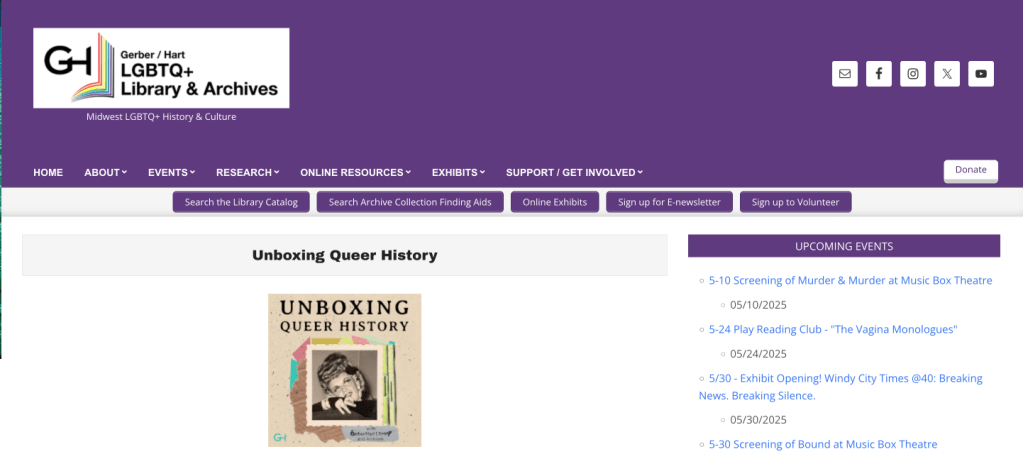
“Unboxing Queer History podcast.” Gerber/Hart Library and Archives. https://www.gerberhart.org/unboxing-queer-history/.
Reviewed by Lauren S.
What do Chicago Drag, a lesbian fishing group, and transGENISIS have in common? The Gerber/Hart Library and Archives! Founded in 1981, the library and archives serves as a repository of LGBTQ history for Chicago and the Midwest at large. The Unboxing Queer History podcast guides listeners through various portions of the Gerber/Hart archival collection, with each of the eight episodes dedicated to a different person or group represented in the collection. An upbeat synth starts each episode, transporting listeners into the podcast to hear from various volunteers, staff, and the very people who contribute to the collections.
The podcast is created by co-hosts Ari Mejia, Jen Dentel, and Erin Bell. Ari Mejia serves as the podcast producer and host who interviews guests and narrates the archival research conducted by Jen and Erin. Jen Dentel began volunteering at Gerber/Hart in 2014 but has since become the Community Outreach & Strategic Partnerships Manager.[1] Erin, who holds a master’s in library science, is the Operations Director and brings her knowledge of available materials at Gerber/Hart. Although we only hear Ari’s voice, Jen and Erin play a major role in editing, researching, and coordinating guests for the show.
While Unboxing Queer History provides a range of profound research conducted by professionals in the archival field, the podcast heavily relies on talking to the people who donate their belongings to Gerber/Hart. This is an invaluable resource, as the podcast creates its own oral public history archive by expanding upon the archived material culture through raw, personal, lived experiences. By expounding upon a different collection each episode, an array of identities and experiences across time offers a glimpse into Midwest LGBTQ history, which is not as expansively offered as other queer history podcasts.
Instead of starting the series with how the Gerber/Hart Library & Archive came to be, the audience is immediately immersed in Chicago drag history, highlighting Miss Tillie’s influence on drag queens from her performances in the 1940s through the 1990s. Miss Tillie is a trailblazer of the Chicago drag scene, and while she was most prolific in the 1960s and 70s, her unabashed and unafraid presence showed other drag queens that it is possible to make your own way, even with all of the oppressive societal obstacles. Although Miss Tillie passed in 2005, the hosts interview historian Owen Keehnen, who is one of the most prolific researchers and activists for Chicago’s LGBTQ+ History. Keehnen’s work includes 100+ interviews with various LGBT authors and activists, a co-authored book on Chicago LGBT historical biographies, and frequently serves as a speaker for Out at CHM, at the Chicago History Museum.[2] In addition to Keehnen’s research, his institutional affiliation with the Chicago History Museum has collections related to LGBTQ+ history and enriches his research.[3] Other podcasts in the field have not offered such a deep throughline of lived experiences, archival collections research, and historical research as this particular episode.
The following episode dives into the history of Gerber/Hart, which began as an entirely volunteer-based working environment. Volunteers became collections managers, donators, and community organizers. Now there are full-time staff positions, but volunteer work still remains at the heart of the library and archive. The episode illustrates the mission of the archive, as directly described by Erin Bell. Further episodes discuss the Amigas Latinas community support group, the People Like Us LGBTQ bookstore, activist and community organizer Lorrainne Sade Bakersville, the Great Angling Lesbian Society (GALS), Bill Kelley’s activism and his material archive as the backbone of the collection, and concludes with a panel conversation comprised of volunteers who put together an exhibition called 1990s Queer Activism.
What makes Unboxing Queer History stand out amongst other podcasts related to LGBTQ+ identities is the direct connection between the archival materials and the interviews of people who experienced the events or participated in the groups mentioned. The eight-episode series not only expounds upon queer and trans people’s lived experiences but also reaffirms people’s autonomy through direct conversations. Unlike other podcasts, you get to listen to the primary people involved in the original creation of the archival material, which is an invaluable resource to the historiography of LGBTQ+ history.
In the episode titled “Amigas Latinas: Latina, Queer, and Together,” Evette Cardona and Mona Noriega, two of the founding members, talk with Ari throughout the episode. While most episodes engage in conversation with historians or people who were involved in the groups or events talked about in the podcast, episodes like “Amigas Latinas: Latina, Queer, and Together” create an oral history while conversing about the material archive. Instead of just a paper or material archive, we get to hear directly from the organizers themselves in their own words.
In addition to incredibly well-researched and produced podcast episodes, the Gerber/Hart website is effortless to navigate, with clearly named sections.
Unlike most podcast websites, the Gerber/Hart website is a repository not only for their podcast but also for their library catalog, archival collection search, online exhibits, opportunities to volunteer, and other ways to get involved—including a wide range of community events. The podcast is on the main page of the website, making the eight-episode series easily accessible. Each episode has its own page with the playback bar at the top and a few selected digitized materials from the person or group that the episode highlights. There is also a brief guide for ways to learn more about the collection focused upon, including archival finding aids specific to the collection described in the podcast, virtual and in-person events, and other relevant information. The podcast effectively uses the digital medium of podcasting by accurately describing the archival content while talking to experts based on personal experience and historians in the field. However, if you are listening without the ability to view the digitized materials, you lose the ability to see corresponding material curated to each podcast episode. With or without viewing the digitized archival materials, the podcast significantly contributes to the field of LGBTQ history.
Unboxing Queer History provides deep analysis of Midwestern and Chicago-specific LGBTQ history that is unique to the Gerber/Hart archival and library collections. The issues that faced Miss Tillie, Lorraine Sade Bakersville, Amigas Latinas, and others mentioned in the podcast remain systemic problems for people who identify as LGBTQ+ today. Unboxing Queer History assures me, as someone who identifies as non-binary and a lesbian, that my queer ancestors are honored and seen at the Gerber/Hart. Even though the systemic forces that attempt to alienate and erase LGBTQ+ people continue to shift, Unboxing Queer History and Gerber/Hart remain steadfast as a community-oriented space to remind us that queer people have always been here and we will continue to be here.
[1] Gerber/Hart LGBTQ+ Library & Archives, Our People, https://www.gerberhart.org/board-of-directors/.
[2] Owen Keehnen, Interviews, https://www.owenkeehnen.com/interviews.
[3] Owen Keehnen, Owen’s Books, https://www.owenkeehnen.com/owen-s-book.
 Podcasting History
Leave a comment