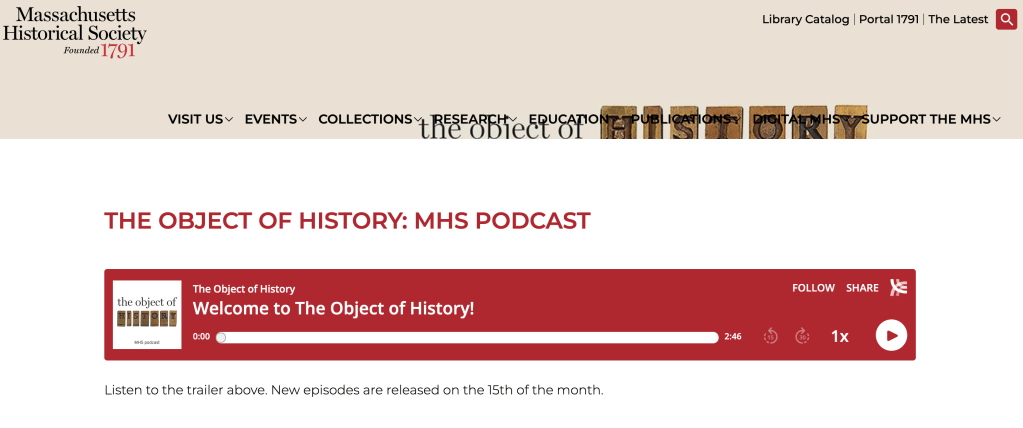
“The Object of History podcast.” Massachusetts Historical Society. https://www.masshist.org/podcast-tooh
Reviewed by Tenzin D.
The Object of History by The Massachusetts Historical Society presents listeners with a wide range of topics. Each episode captures an entirely different story throughout history and the themes of each of the episodes are summarized in the title of the episode. All objects come from the Massachusetts Historical Society’s extensive collection of rare historical objects. The objects in Season 1 of the podcast range from a casket of hair to a hotdog. Expect the unexpected when listening to The Object of History.
The intended audience of the work of The Object of History podcast is mainly intended for the general public. The hosts are Cassie Cloutier, Kanisorn Wongrichanalai, and the Massachusetts Historical Society. Their main goal seems to be to inform and educate the public about artifacts and the stories behind them. The website that this podcast is targeted for those who like learning through “material objects and manuscripts”, who wish they “could hold the documents in a display case at a museum, and those who get chills thinking about how the artifact in front of you belonged to a real historical person”[1]. Even those who are professionals in this field may also gain some knowledge about general history stories they have never heard of before.
This podcast engages the audience in many different ways. Each episode has multiple people talking, which helps keep the listener engaged by hearing multiple different voices. In addition, the podcast brings in multiple guest speakers. The guest speakers are those who have advanced knowledge on the people behind these objects and events happening during the time of these objects. In the Rebecca Nurse Episode, the guest speaker specifically points out the importance of community during this time, “But I think it’s important to know that life really centered on the community and what was in the community’s best interest. We are all about individuality today. And that was very much not the case, then that was certainly a matter of survival.”[2] This example of community unfolds throughout the episode. Community played a huge role in Rebecca Nurse’s story because a large portion of them had her best interest and other’s didn’t. During a time where community was the key to survival, the allegations caused turmoil throughout the community. Rebecca Nurse was a respectable figure in her community and the signatures on her petitions proved that, but it wasn’t enough. The community that Rebecca Nurse once thought had her best interest, was the same community that ultimately betrayed her in the end. The guest speaker uses the context as a background to later then show examples of Rebecca Nurse and the effects of her community. The Object of History does a good job describing the objects in a way that the listener can imagine. They describe the object’s color, size, material and plenty of other aspects. While listening, I could picture the object before I actually knew what it looked like. On top of that, the website allows access for the listener to look at the objects up close and zoom in whenever they would like. It was easy to navigate since the host’s frequently mentioned viewing the objects up close in every episode. The interactive image view was placed right underneath the episode title and listeners had the option to click on any photo that they wanted. There were options on the top right of the image to zoom in, out or see the image full screen. For images with text, there were additional features to view the description, transcription and view the document side-by-side. If the museum had multiple pages of this text, they were all available through this interactive view as well. This engaging component allows listeners to really see the descriptions come to life. For most episodes in season 1, the podcast uses music to engage the listener. The music, usually instrumental, adds a lot of depth to the podcast. It sets the tone for the listener, especially when there were more serious backstories to the objects at hand. It created a lot of emotion and helped with transitions to keep the story progressing.
Most of these objects featured in the podcast aren’t on display in person at the Massachusetts Historical Society. This gives the listener an inside scoop of various artifacts. When people do go see artifacts in person, there isn’t really a detailed story behind them. This leads to the purpose of storytelling, by exploring the objects’ history and the people that were a part of its history. Their goal is to continue to shed light on points of history that aren’t talked about enough or at all during popular times in history that most people know about. Some comments for The Object of History podcast is that they do a good job giving more background on the topic before the episode begins. The podcast covers a lot of the topics in each episode and because the podcast is to inform the general public, this is a nice way to keep them up to date. For example, in the Nora Saltonstall episode, they immediately talk about certain years and big events that the public most likely have heard about to give context. This episode specifically starts by talking about the early 1900’s and World War I. Then the episode goes back to where her journey started and circles back to her impact as a Red Cross volunteer in France during World War I. This leaves the audience with a deeper understanding of the material while still being able to explain topics to those around them, which also allows for an expansion of public history.
The podcast is produced by the Massachusetts Historical Society and its staff. Since this podcast doesn’t have one story that it is continuing to tell throughout the entirety of the season, I will focus on my favorite episode, “Season 1, Episode 6: A Petition for Rebecca Nurse”. Specifically in this episode, they had a special guest, Elyssa Tardif. She is an early American literary scholar who wrote part of her dissertation about the Salem Witch Trials. A lot of the information in this episode about the Salem Witch Trials has aligned with other historians. It rehashes a familiar history that’s been told by numerous historians that include the false accusations and the symptoms of the girls which ultimately led to the divide of that village. The unfamiliarity and anxiety of the people of Salem can be seen in both. In this episode specifically, it brings a new personal perspective to this familiar topic. We have a deep dive into Rebecca Nurse’s role in this point of history. In order to get a deeper understanding, I would have loved to see the episode talk more about Sarah Cloyce and Mary Eastey, Rebecca Nurse’s sisters. Their dynamics at home and how this affected their family after their passing. Elyssa Tardif’s dissertations mentions, “After the trials were over, a person‘s reputation and the taint of a witchcraft allegation or conviction became an obstacle to both financial and emotional recuperation for those who survived.”[3] Three of the daughters of that family had their reputations ruined based on their allegations, what were the long term effects of the allegations to their family? What happened to the girl that accused the sisters, Abigail Williams? The community of the Salem Witch Trials in the present seems to embrace their witchcraft as, “seemingly happy to use the stereotypical image of a witch on a broomstick on many commercial ventures.”[4] Hearing the after effects of the witch trials would have added a new perspective to the podcast, and see if the controversial decisions have any effects to the present. This podcast fits in a larger academic conversation by expanding these familiar times in history while adding a personal touch to see the stories unfold in a different lens. The developer’s storytelling method created an easier way to navigate through this topic in history. The format of the podcast is more conversational. This created an environment where I felt like I wasn’t being talked at, but talking along with. This creates a very inviting way to bring the public in for conversations and questions without the fear of being judged. I think this is an especially instructive way for public historians to inform the public about events in history. Include the audience and ensure that they feel that way.
Overall the value and significance of this podcast plays a significant role as a public history project. Not only does it give the public audience history topics, it allows for a more interactive and unique experience. The Object History isn’t just the history of one object in one point of time, it’s the culmination of the histories of many objects that involve many timelines, people, and the stories that come along with it.
Bibliography
García, Kristina. “Possessed: The Salem Witch Trials.” Penn Today, 11 Mar. 2022, penntoday.upenn.edu/news/possessed-salem-witch-trials.
Hubbard, C. (2022). Haunted Happenings and Hocus Pocus: Memorialization of the Salem Witch Trials—Is Salem Doing Enough? The Pomegranate (Corbett, Or.), 23(1–2). https://doi.org/10.1558/pome.21358
“The Object of History: MHS Podcast.” Massachusetts Historical Society: The Object of History: MHS Podcast, http://www.masshist.org/podcast-tooh. Accessed 20 Feb. 2025.
Saxon, Vicki. “What Caused the Salem Witch Trials? – JSTOR DAILY.” JSTOR , daily.jstor.org/caused-salem-witch-trials/. Accessed 21 Feb. 2025.
“Season 1, Episode 3: The Relics of Nora Saltonstall.” Massachusetts Historical Society: Season 1, Episode 3: The Relics of Nora Saltonstall, http://www.masshist.org/podcast/season-1-episode-3-relics-nora-saltonstall. Accessed 13 Apr. 2025.
“Season 1, Episode 6: A Petition for Rebecca Nurse.” Massachusetts Historical Society: Season 1, Episode 6: A Petition for Rebecca Nurse, http://www.masshist.org/podcast/episode-6. Accessed 20 Feb. 2025.
Tardif, Elyssa. “‘I Have Thought Proper to Inform the World’: Reading Unconventional Testaments of 18th-Century New England Women.” Purdue E-Pubs, docs.lib.purdue.edu/open_access_dissertations/47/. Accessed 20 Feb. 2025.
[1] Staff, The Object of History: MHS Podcast, (Massachusetts Historical Society)
[2] Elyssa Tardif, A Petition for Rebecca Nurse, (Massachusetts Historical Society)
[3] Elyssa Tardif, “I Have Thought Proper to Inform the World”: Reading Unconventional Testaments of 18th Century New England Women, (Purdue University, 2013) 35
[4] Cheryl Hubbard, Haunted Happenings and Hocus Pocus: Memorialization of the Salem Witch Trials— Is Salem Doing Enough?, (Equinox Publishing, 2022) 167
 Podcasting History
Leave a comment